
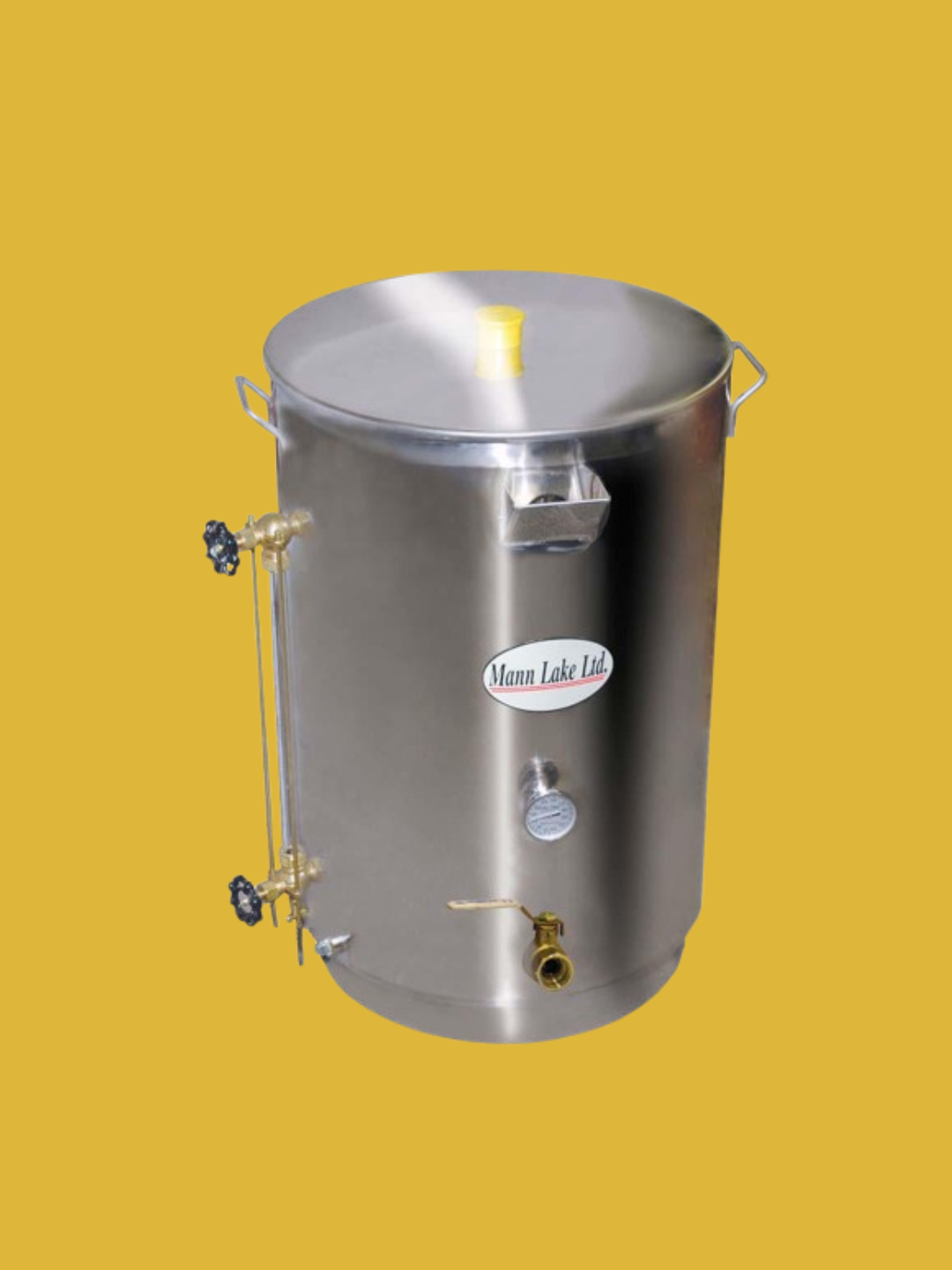
Mann Lake 30 Gallon Bottling Tank
The Mann Lake 30-gallon/350-lb tank is designed to both hold and gently warm honey for bottling. It uses a water-bath/double-boiler system, meaning the heating element warms the surrounding water rather than directly heating the honey. It has a 1,500-watt, 110-volt immersion heater and a stainless drip-free bottling valve.
QUICK USE
Clean —> Fill water jacket —> Add honey —> Set approved temperature —> Warm gradually —> Monitor temperature —> Open valve —> Fill containers —> Turn off heater —> Cool —> Clean & Sanitize
VIDEO ON HOW TO USE EQUIPMENT
How to use
Before you start
Make sure the tank is clean and sanitized.
Place the tank on a stable, level surface.
Make sure the bottling valve is closed.
Confirm that the tank’s water jacket has the appropriate amount of water before turning on the heater.’
Have a clean container ready beneath the bottling valve.
If using a filter basket or filter cloth, make sure it is properly installed.
Do not turn on the immersion heater unless the heating system has been properly filled according to the equipment instructions.
Add Honey
Make sure the bottling valve is closed
Add filtered/processed honey to the tank.
Do not overfill the tank.
Secure the lid, if applicable.
Check around the tank and valve for leaks.
Warm the Honey
Set the heater to the temperature to between 90°F to 100°F (32°C to 38°C).
If honey has started to granulate: 120°F to 140°F (49°C to 60°C) for a short period, but it should be cooled back down to bottling temperature to protect raw properties and enzymes.
Turn on the heater.
Allow the water surrounding the honey tank to warm gradually.
Monitor the honey temperature regularly.
Avoid holding honey above 100°F–105°F (38°C–40°C) for extended periods
Stir the honey gently if needed to distribute heat evenly.
Do not overheat the honey.
Once the honey reaches the approved bottling temperature, turn the heater down and maintain between 90°F to 100°F (32°C to 38°C).
the purpose of the tank’s indirect heating system is to provide controlled, gradual heating rather than applying direct heat to the honey.
Bottle the Honey
Place a clean, appropriately sized container beneath the bottling valve.
Open the valve slowly.
Fill the container to the desired amount.
Close the valve completely between containers.
Check fill weights periodically using a calibrated scale.
Wipe any drips from the valve using the approved food-safe procedure.
Continue until the desired amount of honey has been bottled.
IF USING THE TANK FOR FILTERING
The tank can be used with the filter basket and filter cloth.Install the filter basket and filter cloth according to the equipment instructions.
Make sure the filter is secure before adding honey.
Pour/process honey through the filter.
Monitor the filter as it fills with wax and debris.
Do not allow the filter to overflow.
Clean the filter when necessary.
Continue processing only after confirming that honey is flowing properly..
When Finished
Close the bottling valve.
Turn off and unplug the heater.
Allow the tank and water to cool before cleaning.
Remove remaining honey according to the Honey House procedure.
Remove the filter basket/cloth if used.
Clean the tank, valve, lid, and other food-contact surfaces according to the Honey House cleaning SOP.
Remove wax and honey residue before it hardens.
Clean and sanitize the bottling valve thoroughly.
Allow the equipment to dry completely.
Store with the valve in the appropriate position according to the Honey House SOP.
Important Safety Reminders
Never turn on the heater without the water jacket properly filled.
Do not exceed the Honey House's approved honey temperature.
Do not leave the heating tank unattended while heating.
A full tank can contain up to 350 lb of honey, so it should not be moved when full.
Keep electrical connections dry.
Do not attempt to repair the heater or electrical components.
If the tank, valve, or heater is leaking or malfunctioning, stop using it and notify Honey House staff.
COMMON ISSUES
-
Likely causes:
No electrical power.
Heater or temperature-control problem.
Large quantities of cold honey.
Honey is highly crystallized or viscous..
Troubleshooting:
Verify the outlet and breaker.
Check the electrical connection.
Confirm that the heater is operating.
Allow adequate time for a large volume of honey to heat.
Monitor the actual honey temperature.
If the heater has power but does not heat, discontinue use and have the heating system serviced.
High Priority
The unit contains an electrical heating system. Any suspected heater or electrical fault should be addressed before continuing operation.
-
Likely causes:
Honey is too cold or viscous.
The bottling valve is restricted.
Filter cloth is clogged.
Wax or crystallized honey is blocking the system.
Troubleshooting:
Check honey temperature and viscosity.
Inspect the bottling valve.
Clean the valve if necessary.
Inspect the filter basket and filter cloth.
Clean or replace a clogged filter cloth.
Check for crystallized honey or wax buildup.
Medium Priority
This is primarily a flow and production issue. Check the honey temperature, valve, and filter before attempting to force flow through a restriction.
-
Likely causes:
Debris on the sealing surface.
Worn or damaged valve components.
Valve is not closing completely.
Troubleshooting:
Close the valve completely.
Clean the sealing surfaces.
Inspect the valve for damage or wear.
Replace damaged components as needed.
Avoid using excessive force when closing the valve.
Low Priority
A minor drip is normally a routine maintenance issue. if the valve develops a significant leak, stop operations and correct the problem before continuing production.