
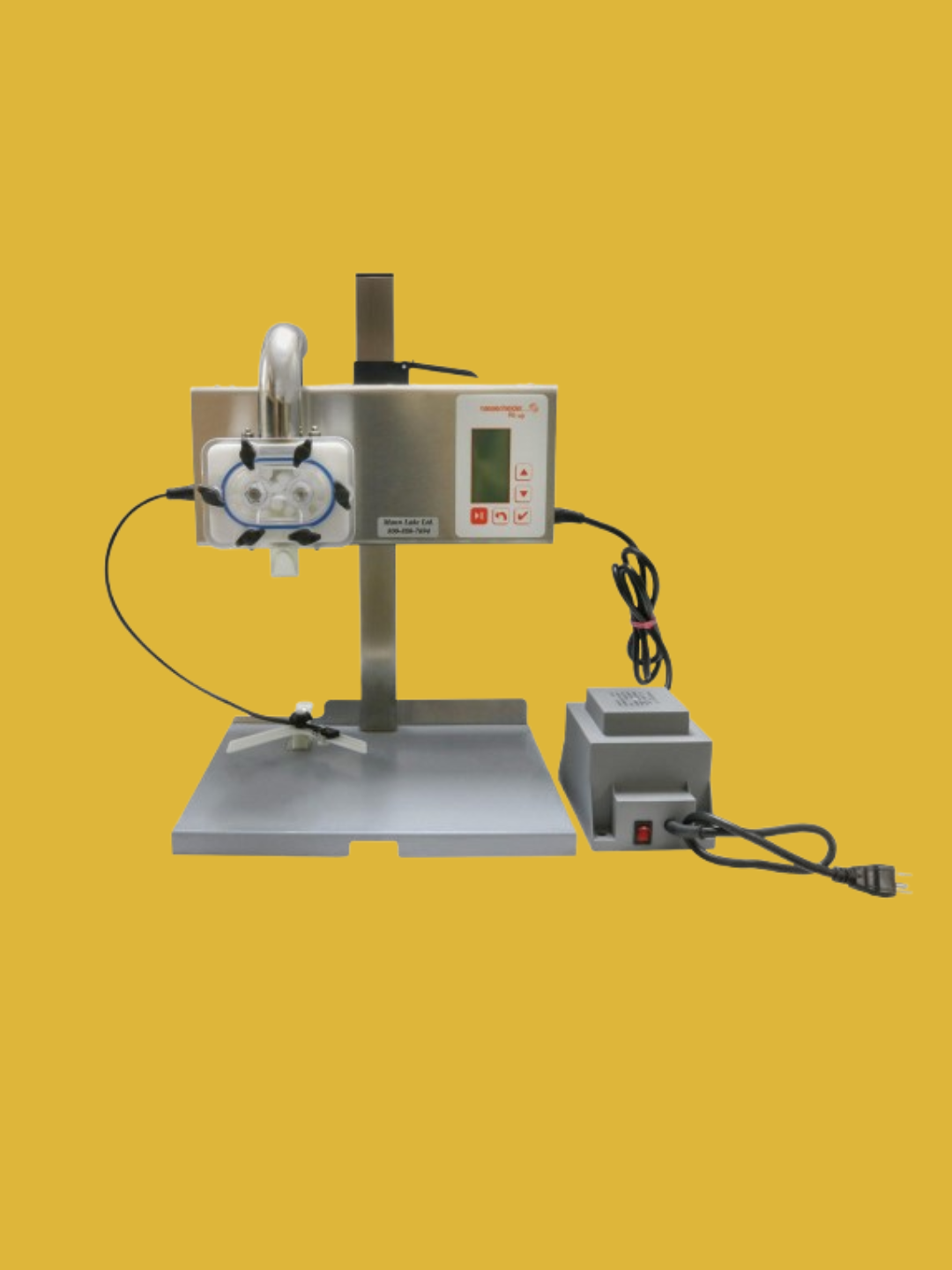
Mann Lake EZ Fill
The EZ Fill is a portable honey bottling system designed for efficiently filling jars and containers with honey. Honey is dispensed through the filling valve, allowing for consistent fills while reducing mess and waste. Its compact, portable design makes it well suited for small-scale beekeepers, honey producers, and shared-use processing spaces.
QUICK TIPS
Always test the first few fills by weight.
Keep the suction hose submerged so air does not enter the system.
Do not allow the pump to run without honey moving through the system.
Keep the nozzle and fill pipe clean and free of crystallized honey or wax.
Never adjust or disassemble electrical components yourself.
VIDEOS ON HOW TO USE EQUIPMENT
How to use
QUICK USE: Clean —> Connect hose —> Submerge hose in honey —> Program fill weight —> Test weight —> Fill containers —> Check weights —> Clean
Before you start
Make sure the EZ Fill and all food-contact components are clean and sanitized.
Place the EZ Fill on a stable, level surface.
Position a clean, empty container beneath the filling nozzle.
Make sure the suction hose, fill pipe, and nozzle are securely connected.
Place the suction end of the hose into the honey you are filling from, making sure it remains submerged.
Connect the unit to power.
Select the Fill Amount
Turn on the EZ Fill.
Program the desired fill weight according to the machine's controls.
Place an empty container beneath the nozzle.
Run a test fill.
Weigh the filled container using a calibrated scale.
Adjust the programmed amount as needed.
Repeat until the fill weight is accurate.
The EZ Fill is designed to fill within approximately 3 grams of the programmed amount, but users can verify the first fills with a scale.
Fill the Containers
Place the empty container directly beneath the nozzle.
Activate the fill using the machine controls or foot pedal, if installed.
Allow the programmed cycle to finish.
Remove the filled container carefully.
Place the next container beneath the nozzle.
Periodically check fill weights throughout the bottling process.
If Honey is Thick
Honey does not necessarily need to be heated for the EZ Fill to operate, according to Mann Lake. However, very thick or crystallized honey may flow more slowly. If Honey House procedures allow warming the honey, use only the approved temperature and warming procedure.
When Finished
Stop the EZ Fill.
Remove the suction hose from the honey.
Allow remaining honey in the system to clear according to the equipment instructions.
Disconnect the power.
Remove the food-contact components that are designed to be cleaned.
Clean and sanitize the hose, fill pipe, nozzle, and other food-contact components according to the Honey House cleaning SOP.
Wipe down the exterior of the machine.
Store the equipment clean and dry.
Finish
Stop the EZ Fill.
Remove the suction hose from the honey.
Allow remaining honey in the system to clear according to the equipment instructions.
Disconnect the power.
Remove the food-contact components that are designed to be cleaned.
Clean and sanitize the hose, fill pipe, nozzle, and other food-contact components according to the Honey House cleaning SOP.
Wipe down the exterior of the machine.
Store the equipment clean and dry.
Important: Keep the electronic components away from water during cleaning. Mann Lake specifically notes that the electronics can be detached for cleaning.
COMMON ISSUES
-
Likely causes:
The suction hose is disconnected or damaged.
Air is entering the suction line.
Honey is too thick.
Pump head or fill assembly is blocked.
Crystallized honey or wax is restricting flow.
Troubleshooting:
Confirm that the suction hose is submerged in honey.
Check all hose connections.
Inspect the hose for cracks or damage.
Inspect the pump head, fill pipe, and nozzle for crystallized honey.
Confirm that the honey is fluid enough to pump.
High Priority
If the pump is running without moving honey, stop the unit and check the suction line and fill assembly. Continued operation may increase wear on the pump and could mean a blockage or other mechanical problem.
-
Likely causes:
Air entering the system.
Partially blocked nozzle or fill pipe.
Inconsistent honey viscosity.
Work gasket or seal.
Incorrect programmed fill amount.
Troubleshooting:
Weigh several consecutive fills.
Check for bubbles in the suction hose or honey stream
Clean the nozzle and fill the pipe.
Inspect the suction hose and connections.
Check the pump head seals and gaskets.
Verify the programmed fill amount.
Recalibrate only after any flow problems have been corrected.
Medium Priority
This issue mainly affects fill accuracy, product consistency, and production efficiency. Correct the cause before relying on the filler for normal production.
-
Likely causes:
Honey is too cold or viscous.
Nozzle or fill pipe is restricted.
Crystallized honey is present.
Nozzle or sealing components are worn.
Troubleshooting:
Check honey temperature and consistency.
Clean the nozzle and fill the pipe.
Inspect for crystallized honey or wax.
Check the nozzle and seals for damage.
Replace worn components as needed.
Medium Priority
This is normally a flow or efficiency issue. If the restriction is significant, correct is before continued use to avoid putting unnecessary strain on the pump.